Why Style Analysis Works
Are there more than seven style essences?
Some theories say yes.
Below we’ll ask and answer:
Why are there just seven essences?
Could there be others?
As a spoiler, my perspective is that there are only seven essences, and that the vast majority of people will find that the seven essence system captures them extremely well.
(In a future post, we’ll discuss whether there are subtypes that exist within a given essence ((such as two distinct kinds of Ethereals)), and whether that’s relevant to your personal understanding of your style type.)
Why Seven Essences?
Why just seven? Could there be more? Where do these essences come from?
The basic answer is that the essences emerge from interactions between line and length. This can be seen in the following chart:
Chart: Where do the Seven Essences Come From? Line and Length.
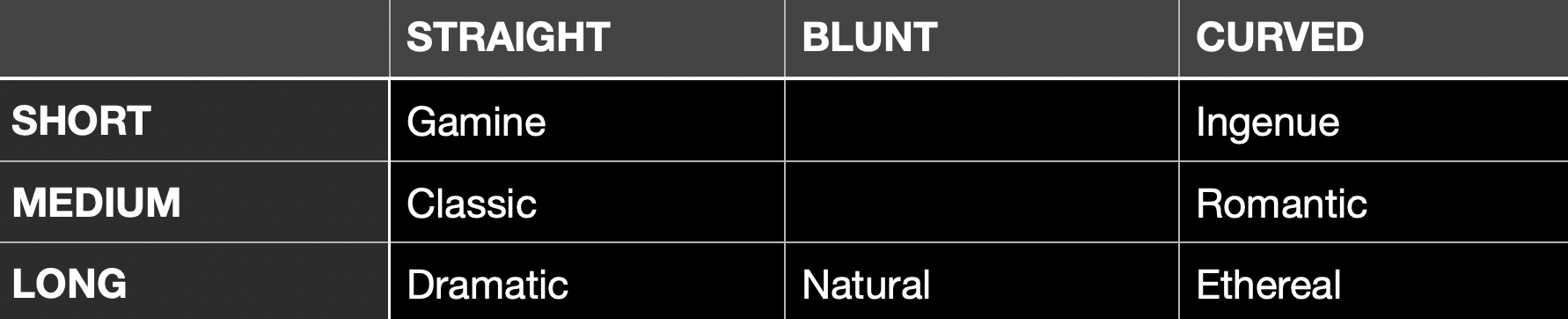
When it comes to fashion and length, Gamine and Ingenue are defined generally by short lengths; Classic and Romantic by medium/moderate lengths; and Dramatic, Natural, and Ethereal by long lengths. When it comes to lines (or shapes), Dramatic, Classic, and Gamine are straight; Natural is blunt (straight with rounded corners, or straight with just a very slight bend); and Ingenue, Romantic, and Ethereal are notably curved.
That table seems relatively uncontroversial. And I think the information in it is all correct. But there’s also some key missing details.
So let’s clarify issues regarding Dramatic, Classic, and the gaps in the “Blunt” column!
Dramatic and Classic Clarifications
Dramatics are amazing in elongation. But they can also pull off some straight and very short styles, like ultra-short hair, very short sheath dresses, and minimalist mini skirts. Dramatic is an essence of extremes.
So, if we want to be thorough, then Gamine is getting a roommate:
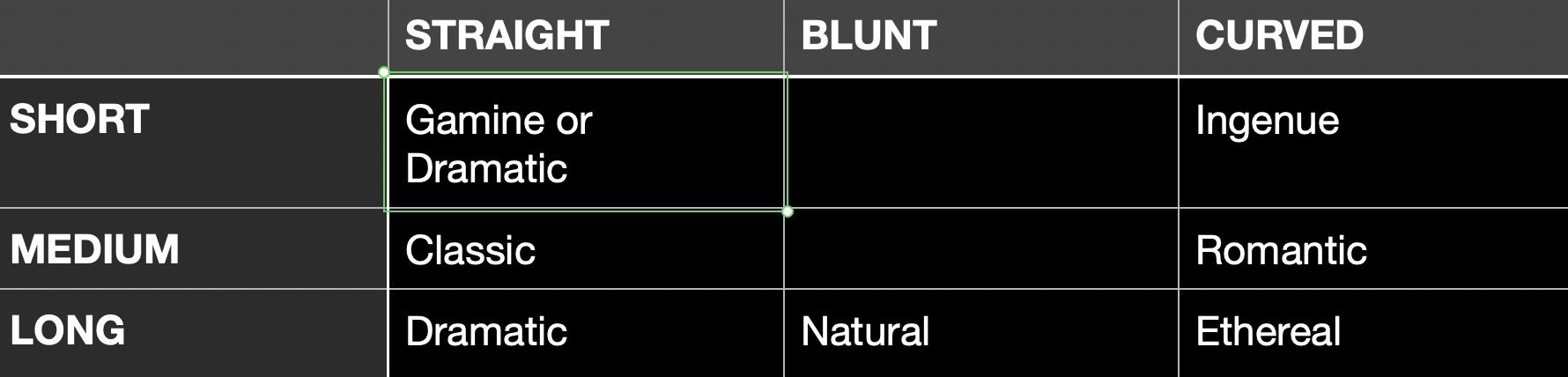
Based on their most flattering fashion, both Gamine and Dramatic deserve a spot in the “Straight and Short” box—even if it seems a little strange for two essences to share the same conceptual space. (It’s also pretty on-brand for imposing Dramatic to infringe on someone else's territory.)
The updated table is more accurate. It now reflects that some straight, short styles (those with playful detail) are Gamine, but that other straight, short styles (those with minimalism or intimidating detail) tend to be Dramatic.
And in-between, moderate-length straight fashion (like simple straight-leg dress pants; tailored basic blazers; and straight, shoulder-length hair) tends to be Classic. So that’s why Classic gets the “Straight and Medium” box.
Let’s be Blunt
Now let’s address the more glaring issue—the two empty spaces in the blunt column! What do we do about those?
In contrast to the rest of the chart, those two spaces seem much more debatable.
But to me, there are very clear answers as to what should go there.
So here’s what belongs in “Blunt and Medium:”
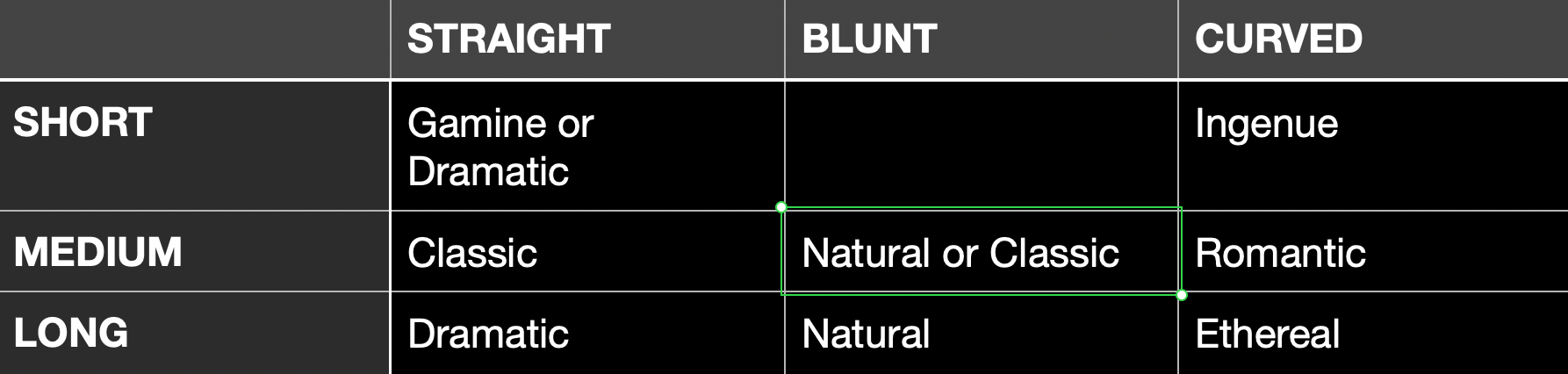
This decision reflects the fashion that is widely recognized to flatter Naturals and Classics.
Specifically, it’s clear that moderate-length, blunt-edged fashion—like typical-length wide-leg jeans or typical-length baggy tees—works well for Naturals.
Natural is flattered by elongation, like tops that extend beyond the hips. But standard-length, blunt-edged fashion can also easily have a casual, conventional, carefree Natural vibe.
Similarly, Classics are flattered by sharp and sleek styles, but also by standard-length tops in soft material that can be described as “blunt-edged.” And while medium-length straight hair easily reads as Classic, so does hair with a slight, controlled bend. So, Classic also makes sense in the “Blunt and Medium” square.
I also like Classic there for a couple theoretical reasons:
It puts Classic in the center of all nine boxes, which reflects theoretical conceptualizations of Classic as representing an average of all the other essences.
(This point will be important to our exploration of whether there are more than seven essences.)
It puts Classic next to Romantic, illustrating the Romantic-Classic connection.
It reflects the fact that Classic has variation in how casual vs. formal it can feel. Classic can feel ultra-polished and dressed up, like a suit that could be worn on a red carpet (this is the side of Classic that’s like a more moderate version of Dramatic). But Classic can also feel somewhat casual, since straight-leg jeans and basic tees can fully be Classic, as long as they feel polished and don’t appear baggy (and this is the side of Classic that’s like a more moderate version of Natural).
But… aren’t we double-dipping on Natural and Classic?
Yes! But as discussed above, it seems justified to do so for Dramatic—in fashion, Dramatic occupies the “Straight and Long” conceptual space and can also occupy the “Straight and Short” conceptual space.
So, there’s no reason why Natural and Classic can’t also occupy more than one box.
Justice for Gamine
We have one more space to fill: “Blunt and Short.” And I think Gamine fairly belongs in that space, since:
One side of Gamine fashion is defined by sharp angles, like cropped structured jackets and stiff, tailored shorts—that’s the “Straight and Short” side of Gamine.
But there’s a different side of iconically Gamine fashion, namely athleticwear: soft, non-stiff tees, shorts, and capris with playful detail like stripes or athletic piping. These are also iconically Gamine.
These Gamine pieces don’t tend to be tailored or heavy enough to hold a completely straight shape. But they’re also not notably curved or draped—they occupy the in-between, blunt-edged space.
Therefore, Gamine belongs in “Blunt and Short”:
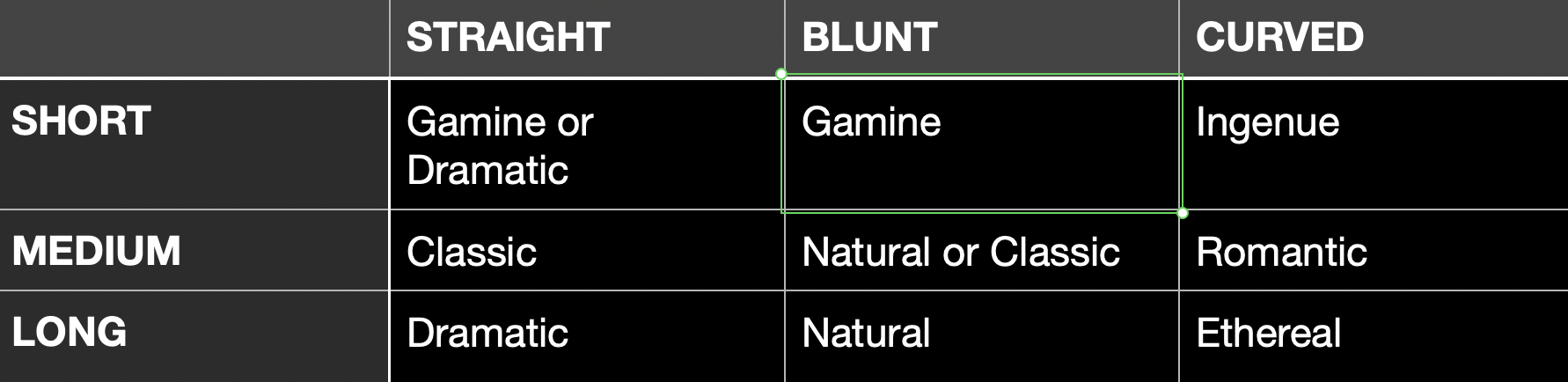
And what’s really satisfying about this is that Gamine now has a box that’s completely its own! In fact, there’s now exactly seven boxes that house just one essence each—one for each of the seven essences.
Setting Boundaries
So, we have this chart that accurately categorizes the seven essences based on their lengths and their line shapes.
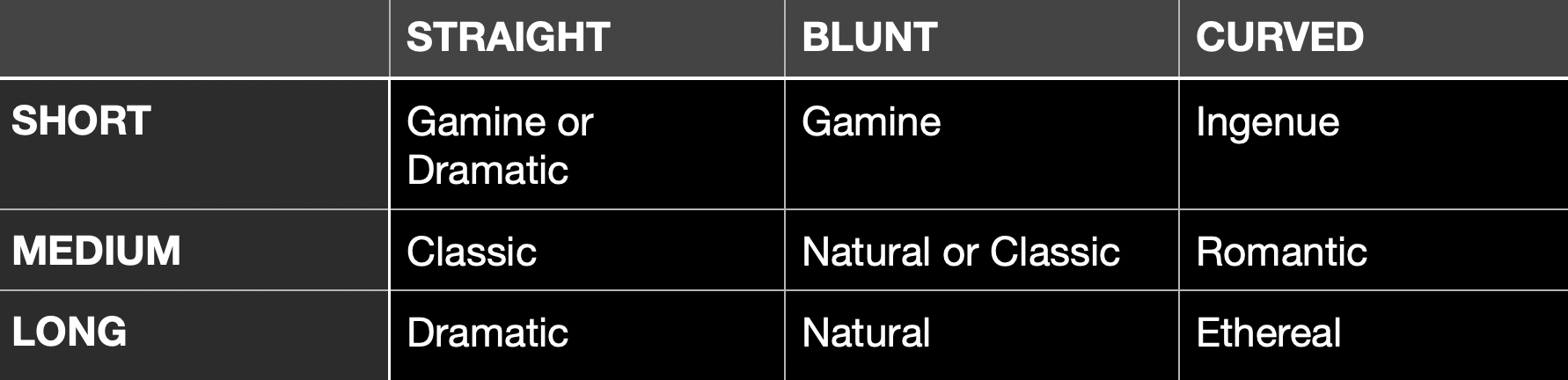
The chart is great especially because it’s parsimonious (simple yet comprehensive): there are nine spaces, but we were able to fill them with the seven essences in a way that accurately reflects the fashion that flatters every essence.
But, we should ask whether the chart should contain additional categories and spaces, and additional essences.
Specifically:
Have we accounted for all the lengths?
Our chart only has three different lengths—Short, Medium, Long—which at first seems like a big problem. What about extra-short and extra-long? What about short-medium and medium-long? What about extra-extra-short?
But the catch is that we don’t need to include all the possible lengths that exist in numerical space. We just need to include the lengths that are relevant to fashion.
Viewed from this lens, the short, medium, and long categories are surprisingly comprehensive.
This is because Gamine, Dramatic, and Ingenue fashion can capture short and extra-short lengths (and extra-extra short and extra-extra-extra short, etc.)
For example, a very short skirt will often feel playful and Gamine. Same with a very, very short skirt. And if the skirt is so short that it’s absolutely shocking and there’s hardly any fabric there, then that length will tend to read as edgy and Dramatic.
So, we don’t need to add separate categories for “Extra-short” or “Extra-extra short”—those are already covered by Dramatic, Gamine, and Ingenue.
Similarly, we don’t need categories for “Extra-long” or “Extra-extra long”, because Dramatic, Ethereal, and Natural fashion already includes “extra-long” pieces. For instance, floor-length pants can be any of these essences. And if you have a veil that’s so long it trails along the ground, then that will typically read as Ethereal.
So the seven essences are fully capable of capturing even the most impractically long (and short) fashion.
What about short-medium and medium-long? This is where the genius of Classic comes in.
Let’s say a garment isn’t quite short enough to be fully Ingenue but isn’t quite moderate enough to be fully Classic. In this case, it will typically have both essences—essentially, it will be an Ingenue piece that’s a little more moderate (Classic) in length than the typical Ingenue piece.
Similarly, if you have a medium-long Ethereal garment, and it doesn’t feel quite long enough to be fully Ethereal, then it will often read as Ethereal Classic.
The same is true for the other essences: if a garment feels like a more moderate length than is typical for that essence, it will often read as having some Classic.
So, we don’t need new essences to capture in-between lengths like short-medium or medium-long. The moderate, balanced Classic essence already covers that.
Have we accounted for all the lines?
Yes—in fashion, a line can be notably straight, or notably curved, or slightly in-between. (Maybe in theoretical physics or something, they have other line types, but for the purposes of fashion, we don’t seem to need any more.)
Of course, a line can also be simultaneously straight, curved, and in-between, but style analysis already accounts for that, because you can have an essence blend that combines essences that prefer different line types, like Dramatic Romantic Natural.
And lines can form an infinite amount of distinct shapes (or, in fashion lingo, silhouettes), both 2D and 3D (e.g., squares, rectangles, figure-8s, etc.).
But the important point here is that style analysis isn’t merely about literal shapes. Style analysis is primarily about the vibes created by those shapes.
So, even though straight lines can be formed into many different shapes (silhouettes), the vibe of elongated geometric shapes will tend to be striking, powerful, and Dramatic, whether that’s a triangle or rectangle or dodecahedron, and whether it’s flat or 3D.
This is true for all the other essences, too. For instance, long ovals, stretched figure-8s, elongated S-curves, narrow spirals, etc.—these diverse shapes all read as dreamy and Ethereal, because they’re all “Curved and Long.”
And again, style analysis accounts for blended shapes, too, like a combination of an oval and a rectangle—if you wear a shirt that has an oval neckline and a long, sharp, boxy bodice, that can be Ethereal Dramatic.
So, we don’t need additional categories for line (or silhouette). Straight, Blunt, and Curved ends up being highly comprehensive.
Beyond Length and Shape?
So our chart covers length and shape. But what about the other elements that exist in fashion (and faces), like textures, colors, and figurative vibes?
The answer is that the chart actually accounts for all these elements, too.
This is because the lengths and shapes that define the style essences (in fashion and faces) are what is used to determine the textures, colors, and vibes that suit all the essences.
For instance, Dramatic is flattered by intense, powerful-feeling fabrics (leather, snakeskin, alligator, etc.) as well as intense, powerful-feeling colors (very deep red, orange, purple, etc). And this is because long, straight lines feel figuratively intense and powerful.
Similarly, Romantic is flattered by extravagant-feeling fabrics like silk and velvet, and passionate colors like deep pinks and reds. And this is because Romantic’s very curvy, circular shapes tend to feel figuratively extravagant and passionate.
This is true for all the other essences, too: the textures, colors, and “figurative vibes” that flatter the essences are based on those essences’ defining lengths and shapes.
So we don’t need a “texture” category, a “color” category, or a “vibes” category in our chart. Those categories would be redundant.
What about Color?
This also helps to explain why you don’t want to use a person’s color season to help determine their style type.
There’s many reasons why this isn’t the ideal approach, including that the shapes in our faces more strongly communicate figurative vibes than the colors in our faces.
(Meaning, having long, striking Dramatic facial features will make a face feel striking and powerful, even if you have very gentle, delicate coloring.)
Plus, trying to use color season to determine a person’s style essences really lacks specificity.
For example, Dramatics are sometimes stereotyped as having high-contrast coloring, but the truth is that Romantics and Gamines can also be extremely flattered by high contrast—and this is true of nearly all the other style essences, too.
So it’s an unhelpful stereotype that if you have high contrast or deep coloring, that automatically means you have Dramatic. It doesn’t fit with the reality that essentially all of the other essences can handle dark colors and high contrast.
Surprisingly Comprehensive
At first glance, our chart seemed too simple to account for all the different kinds of fashion (and faces!) that exist.
But thanks to the flexibility of all the essences, and to Classic’s moderating influence, we don’t need any other essences to account for different lengths and shapes—and for the figurative vibes those lengths and shapes produce.
So, based on all this, and based on observations about how well the seven essence system captures such a diverse range of people, it really appears that there are only seven style essences.
Subtypes?
So, there are seven style essences.
But. Could there still be essence subtypes?
Meaning, within a single essence category, such as within the Ingenue category, could there be distinct kinds of Ingenues?
I think the answer to this can honestly be yes or no, depending on your perspective.
You don’t need the concept of essence subtypes to understand your beauty.
The seven essence system is already highly comprehensive.
But if you want to be ultra-specific with defining your style essences, then I do think there is a sense in which we could create subtypes for each of the core seven essences.
More on that in future posts!