Style Essence Subtypes?
Are there style essence subtypes?
Depending on your perspective, the answer can be yes or no…
Essence Subtypes: Quick Overview
Last time, we discussed where the style essences come from.
We demonstrated that they emerge from combining different line shapes (Straight, Blunt, Curved) with different lengths (Short, Medium, Long):
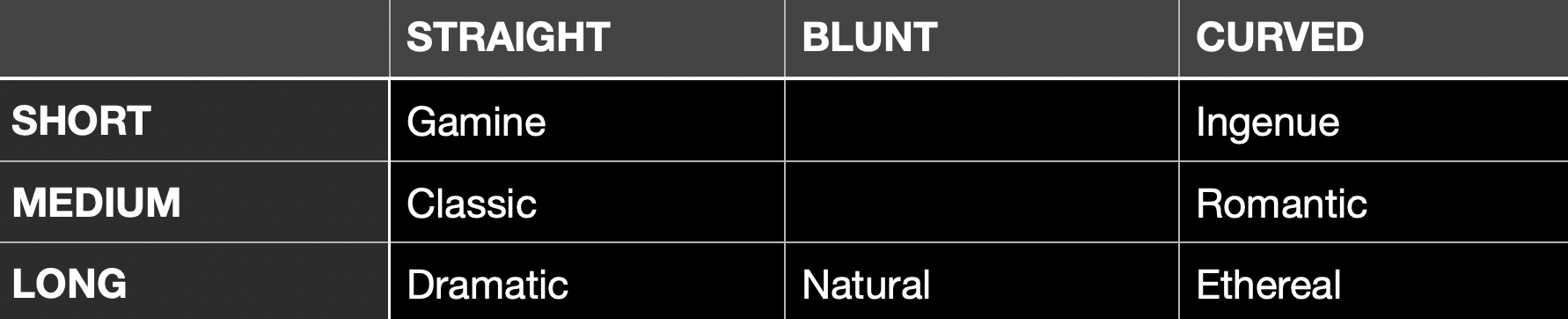
So, we filled that chart with our seven essences… and realized that it had some gaps!
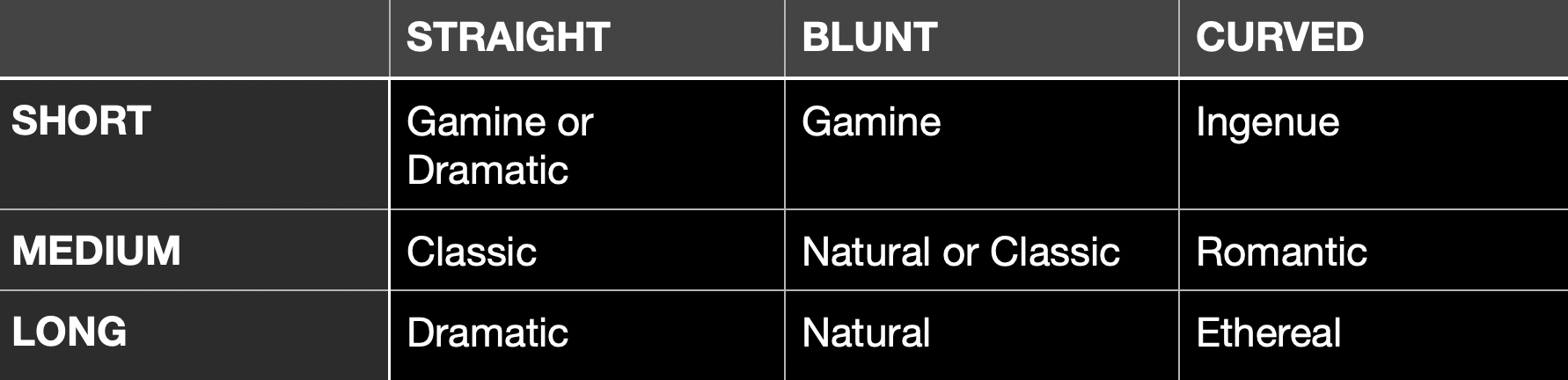
And here’s the most accurate, parsimonious way to complete it:
For an explanation of why the chart should look like this, see last week’s post.
The general summary is that this chart reflects the fashion that truly flatters each essence.
Specifically, Dramatic fashion can be long or short. Natural—long or standard-length. Gamine—sharply-tailored (Straight) or unconstructed (Blunt). Classic—Straight or Blunt.
This completed chart reveals that some style essences occupy two distinct visual realms.
For example, Dramatic occupies both Straight and Long and Straight and Short.
So, that brings up the question: are all Dramatics flattered by all types of Dramatic fashion?
Or is there one Dramatic subtype who is more flattered by Straight and Long fashion, and a different Dramatic subtype who is more flattered by Straight and Short fashion?
And what about Classic, Gamine, and Natural? Could they also have subtypes?
And what about Ingenue, Romantic, and Ethereal?
My honest answer is that yes, it’s possible to identify essence subtypes.
But whether it is truly meaningful or necessary seems to be a matter of opinion.
You Don’t Need to Know Your Subtypes
The seven essences already provide a comprehensive roadmap for honoring and enhancing your unique beauty—even if you don’t consider subtypes at all.
See last week’s post for more about just how comprehensive the seven essence system is!
So, I can’t stress enough—you don’t need to learn your subtypes, or learn about subtypes at all.
Just knowing what your essences are, by using the seven essence system, is typically enough to look amazing.
Learning Your Subtypes Might be Helpful
But, if you’re a style essence enthusiast, or if despite knowing your style type, you’ve struggled to make it work for you, then it might be really useful to learn your subtypes.
Below we’ll discuss what the subtypes are and how to figure out which ones you have.
Style Essence Subtypes
A general important point is that if you have an essence subtype, it’s always going to be a version of one of your core essences, rather than an essence that you don’t have.
For instance, if you’re a Dramatic Gamine Ingenue, and those are your only essences, then it’s not possible for you to have a Classic subtype.
It’s also not possible for a Dramatic Gamine Ingenue to have a Natural, Romantic, or Ethereal subtype.
The point of a subtype isn’t that you have a new essence; it’s that you have a specific version of one of your existent essences.
Classic Essence Subtypes
So based on the fashion that genuinely flatters the essences, here are the two main Classic subtypes:
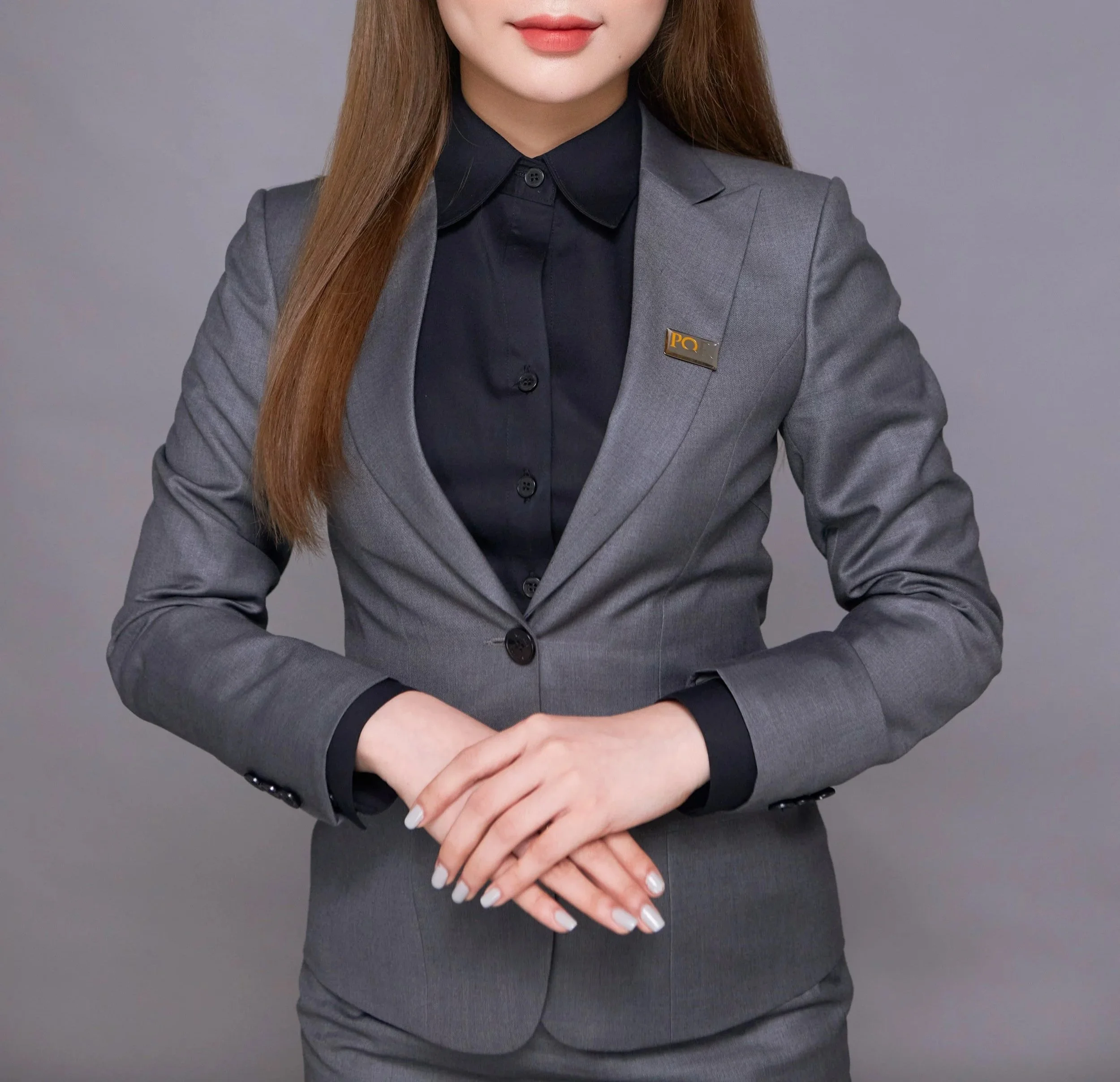
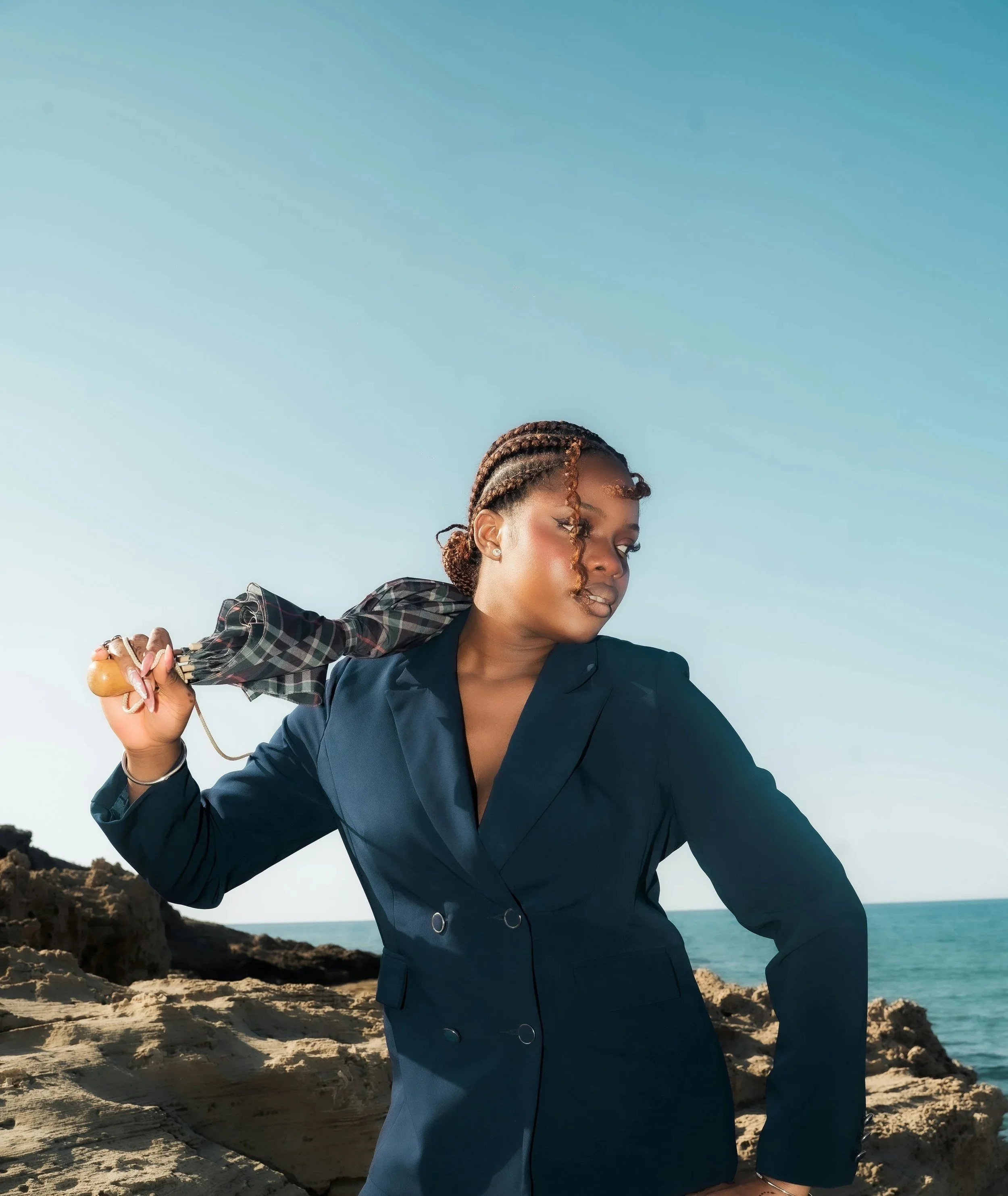
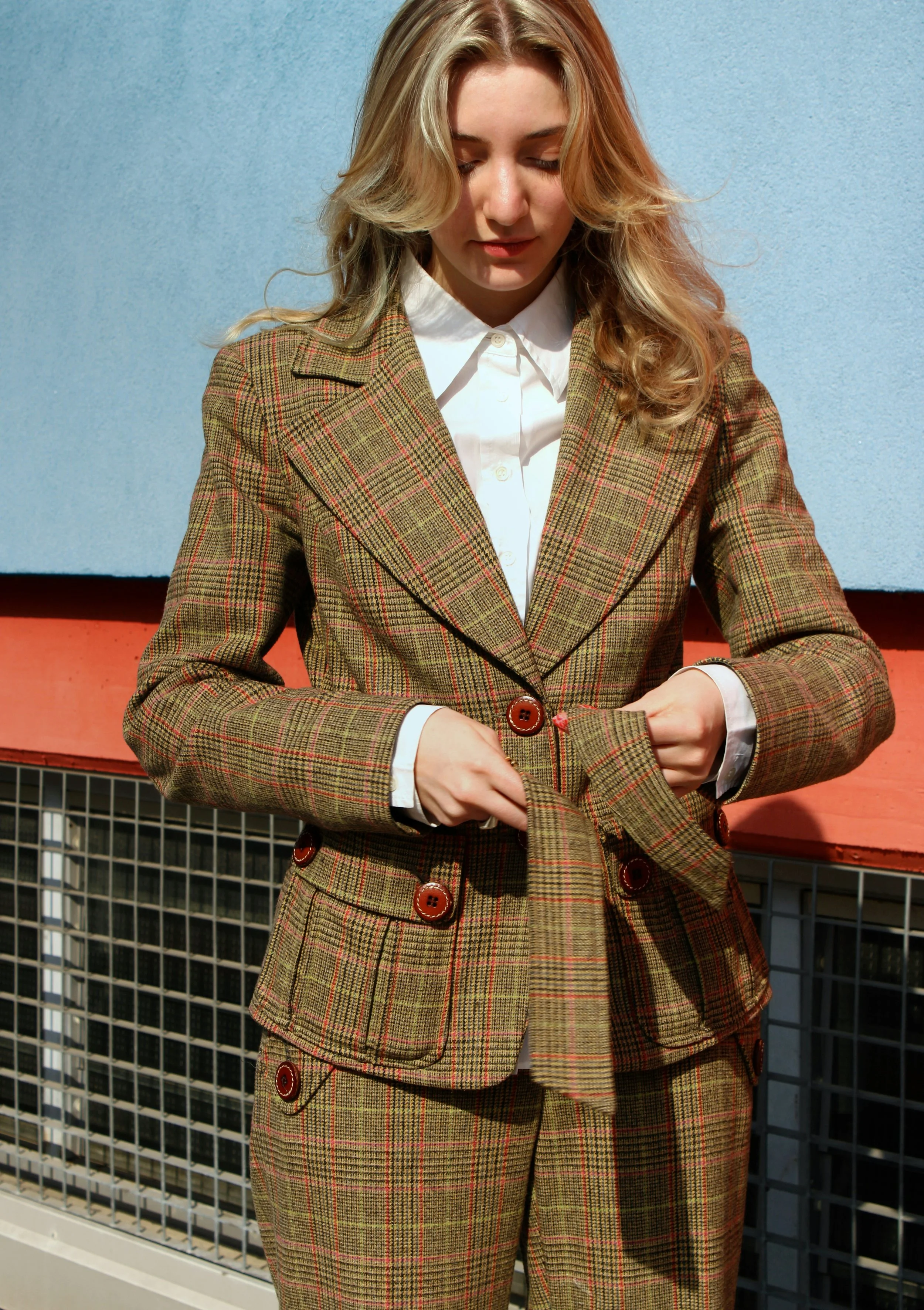
Subtype #1 is the Formal Classic, flattered by:
Timeless, often business-like attire, with sleek, stiff, tailored silhouettes:
Subtype #2 is the more Casual Classic, flattered by:
The more everyday, less tailored, less formal side of Classic fashion
This includes basic crisp tees, straight-leg jeans, and other informal basics:
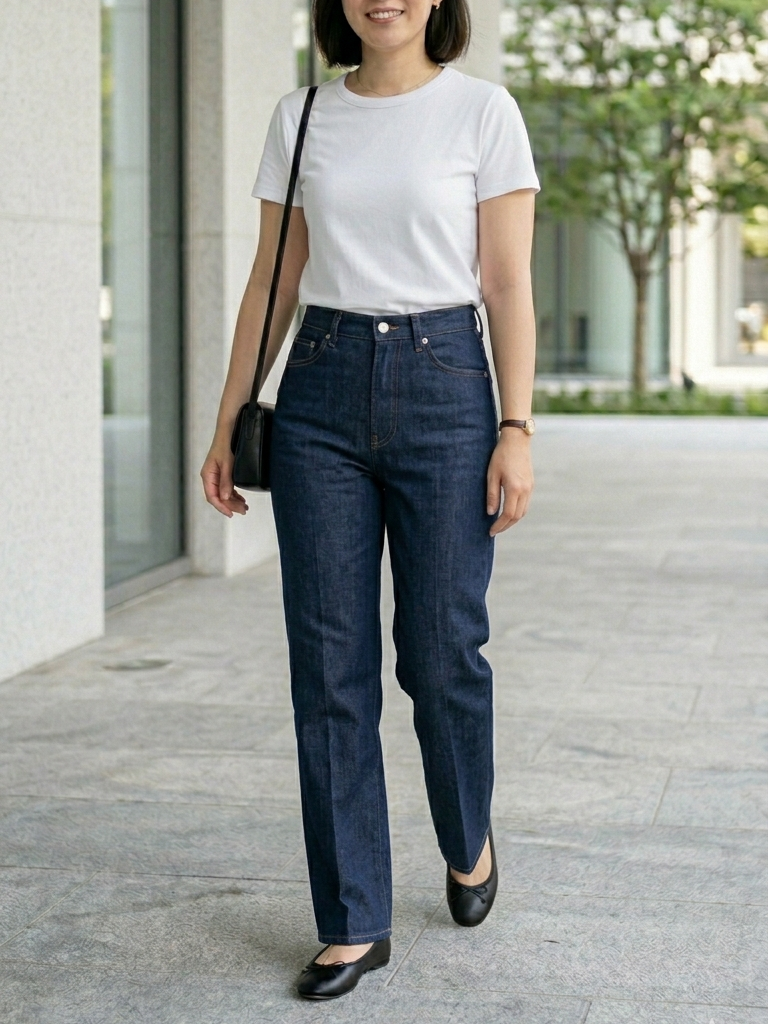
This outfit is fairly casual, but it still has the minimalist, polished Classic feel.
It does feature a tee and jeans, which can make us think of Gamine fashion—but this outfit isn’t playful or detailed enough to have Gamine.
It’s also not quite carefree or laidback enough to have Natural (we’ll discuss more about that in Natural’s subtype section!)
Importantly, these subtypes aren’t random—they’re based on the fashion that genuinely flatters Classic, which are summarized in our chart:
As seen in our chart, the “Straight and Medium” Classic is the Formal Classic Subtype. This version of Classic fashion is like a more moderate, understated version of Dramatic fashion.
And as seen in the chart, the Classic defined by “Blunt and Medium” lines is the Casual Classic Subtype.
(As we’re going to see further when we discuss Gamine and Natural subtypes, Straight fashion tends to read as more formal, whereas Blunt fashion tends to read as more casual!)
Classic Subtypes in Faces
The simple difference between these two Classic subtypes in faces?
The sharpness of the features.
Both Classic subtypes will have features that appear proportionate, balanced, and generally symmetrical.
But the Formal Classic subtype will tend to have sharper or more angular features, while the Casual Classic subtype will tend to have blunter features.
How to Find Your Subtype
To determine your subtype, you’ll want to observe which form of Classic fashion most flatters you—formal or casual.
You might also be able to discern your subtype simply by studying the literal shapes of your features.
However, this can be difficult to do with the naked eye—especially because you likely have other essences besides Classic, and it can be tricky to disentangle which of your features have which essences.
Do You Need to Know Your Subtype?
Not necessarily.
This is because even though the Classic subtypes are distinct, the overall vibe of both is relatively similar.
So, you might find that regardless of whether your facial features read as straight or blunt, you can harmoniously wear both kinds of Classic fashion.
With that said, it is possible that some people will find that one of the subtypes of Classic fashion is much more flattering than the other.
Are There Other Classic Subtypes?
At least when it comes to faces, I think the answer is yes.
This is because it’s possible to have the Classic essence without actually having any Classic facial features.
How? Because it’s possible to have Classic in the spacing between your features (meaning your features appear very balanced and proportionately spaced).
If that describes you, then you may find that either Classic subtype works for you.
It’s also possible that you’ll prefer the more formal side of Classic fashion, since the balanced spacing of your features mimics the precision of Formal Classic.
Gamine Essence Subtypes
Gamine also has both a more formal and a more casual subtype:
Subtype #1 is the Casual Gamine, who is flattered by basics that almost look like understated Natural or Classic basics (like jeans and tees), except that something has been done to them to make them feel distinctly playful, fun, or flirty:
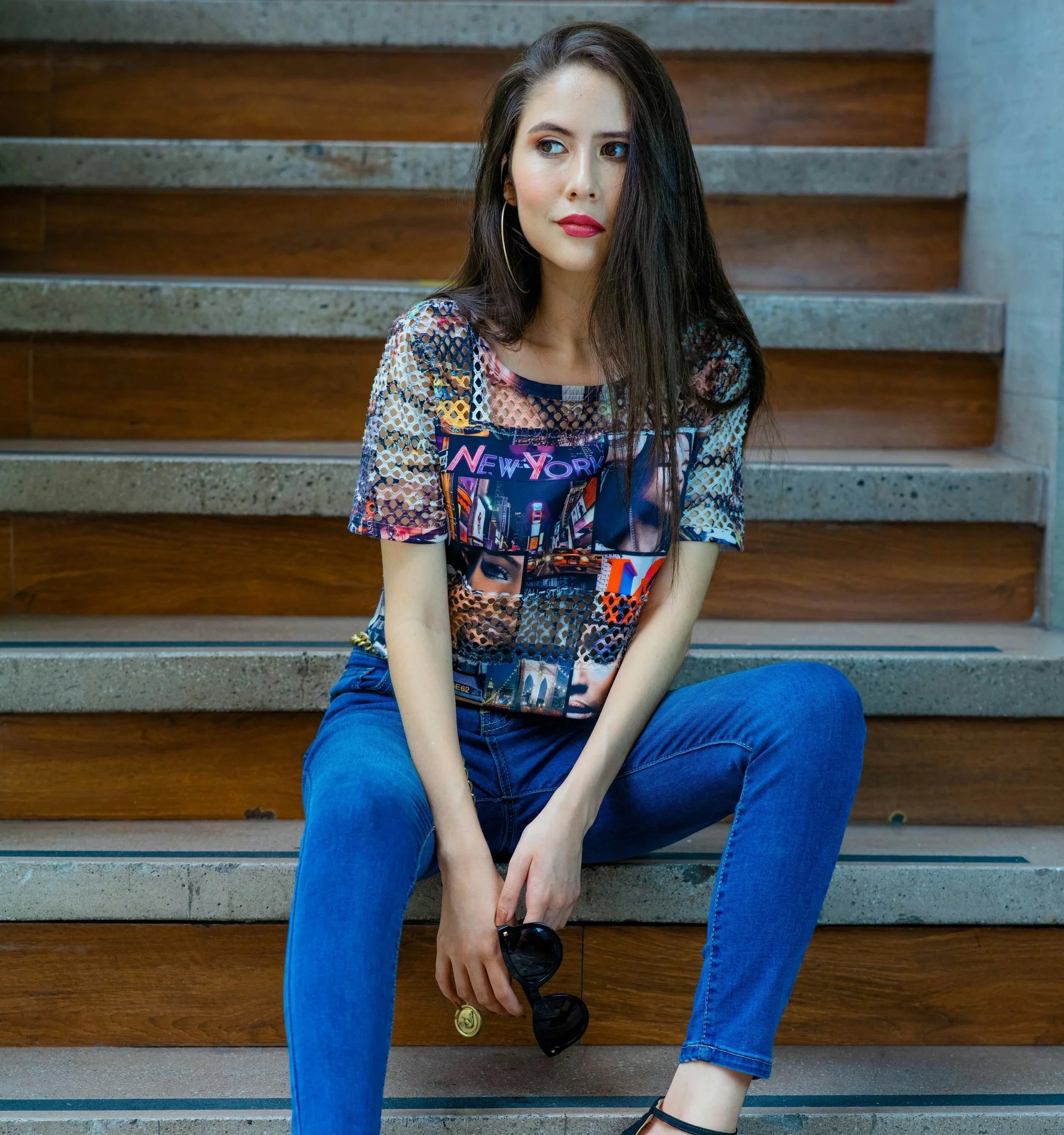
Skinny jeans and boxy cropped tees with fun prints or small geometrics are iconically Gamine.
These silhouettes are much narrower (skinny jeans) or cropped/shortened (boxy crop top, miniature print) than Natural or Classic silhouettes tend to get.
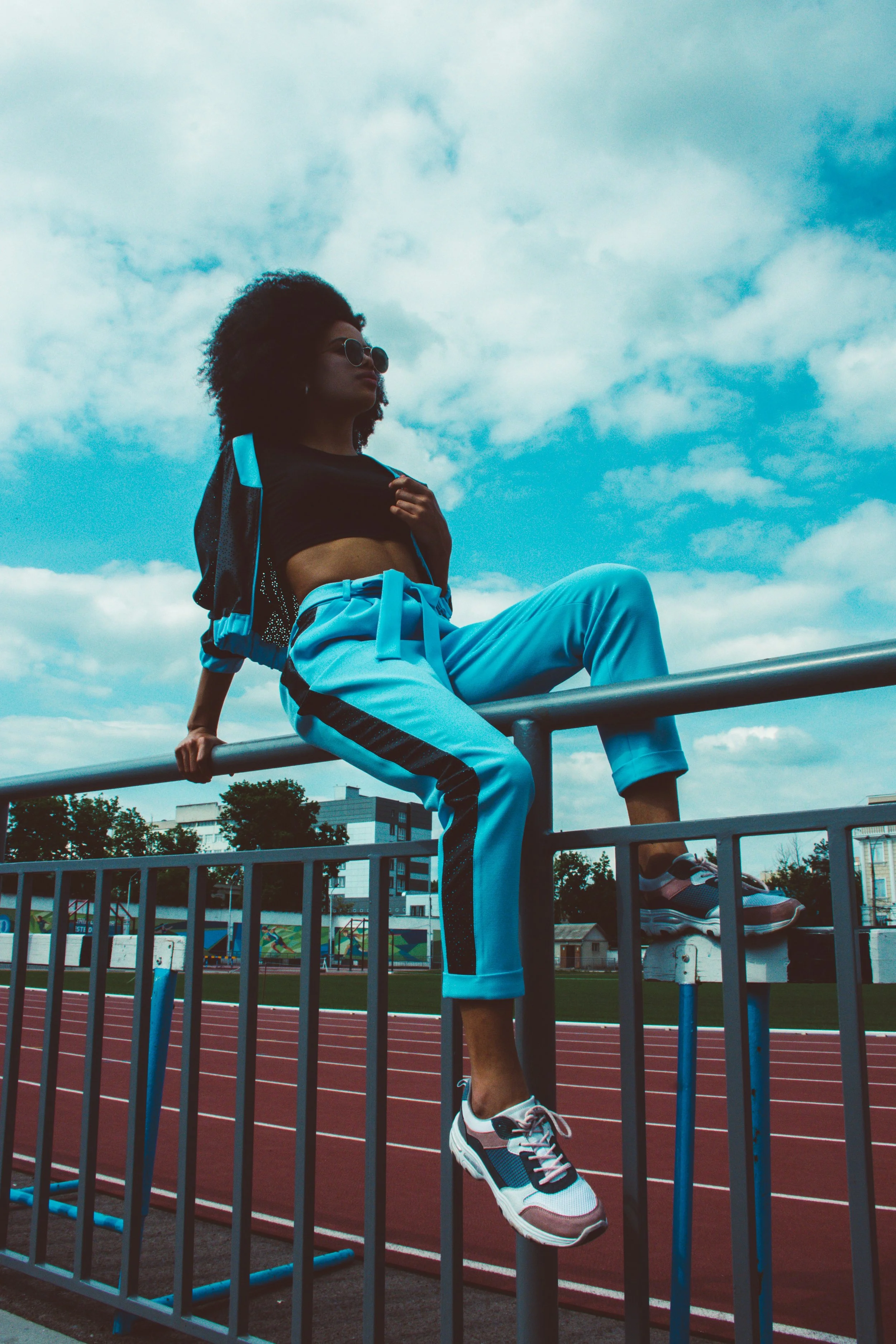
Playful-feeling cropped athleticwear also tends to fit this Casual Gamine subtype:
Gamine Subtype #2 can be called Formal Gamine. Think cropped blazers and skinny or tapered non-denim pants with contrast hardware:
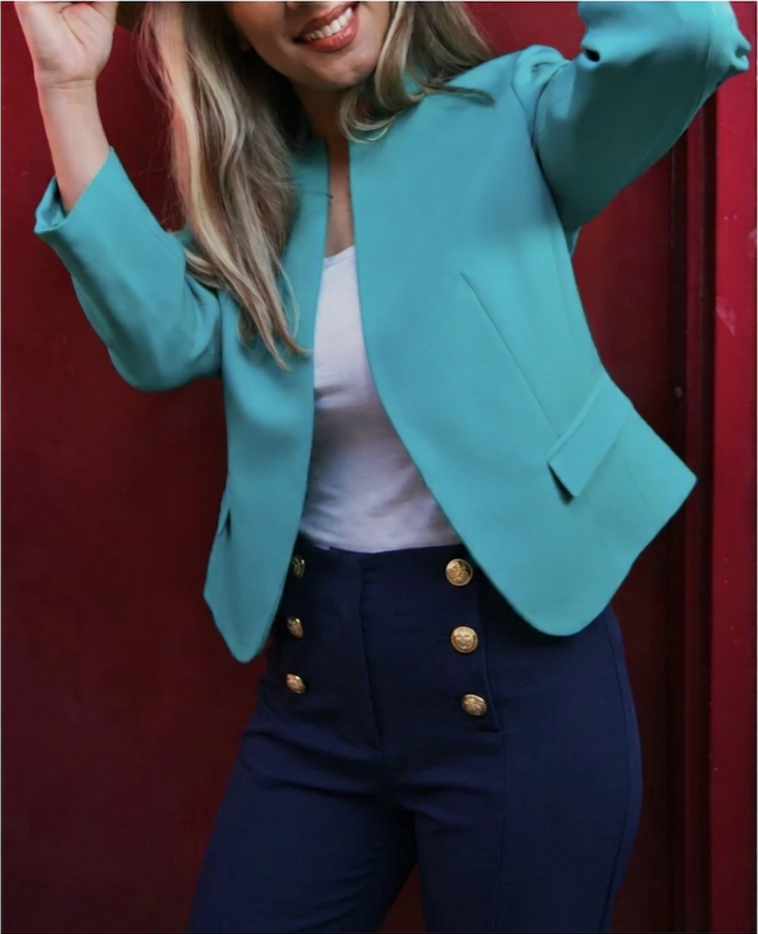
Cropped, structured Gamine pieces (like this bold blazer and sailor-style pants with contrast buttons) represent the dressier side of Gamine.
Importantly, these subtypes aren’t randomly determined. They’re based on the fashion that truly flatters Gamine, summarized by our chart:
In our chart, the “Straight and Short” Gamine is the Formal Gamine Subtype. This version of Gamine tends to feel tailored, like the blazer outfit above.
And on our chart, the “Blunt and Short” version of Gamine is the Casual Gamine Subtype. This version of Gamine tends to read as a more playful or cropped version of laidback Natural fashion.
As was true when we discussed Classic, Straight lines in fashion tend to read as more formal, whereas Blunt lines tend to read as more casual.
So, it makes sense that Classic and Gamine both have a more formal and a more casual subtype, because these essences occupy both the “Straight” column and the “Blunt” column.
Gamine Subtypes in Faces
As illustrated by our chart, people with the Casual Gamine subtype will tend to have short, blunt-edged features, while people with the Formal Gamine subtype will tend to have short, sharp features.
This distinction makes sense of something I’ve long observed, which is that some Gamines have sharp features, and some don’t—in fact, some Gamines have eyes, noses, and face shapes that almost appear round.
So, the fact that there’s a “Blunt Gamine” subtype helps explain why some Gamines have non-pointy features.
How to Find Your Subtype
You might simply be able to look at your features and get a good clue as to whether they appear blunt or sharp.
However, facial features don’t always appear to the naked eye the way they appear when draped in your most flattering fashion.
So the better strategy may be to observe whether you’re flattered more by Gamine’s Casual or Formal side.
Do You Need to Know Your Subtype?
Not necessarily.
Ultimately, your best fashion is more about your features vibes than literal shapes.
So regardless of whether your Gamine facial features are sharp or blunt, you may find that you can pull off both kinds of Gamine fashion (even if one does appear slightly more flattering on you than the other).
Alternately, it is possible that based on your specific features, you’ll prefer one subtype far more than the other.
Are there Other Gamine Subtypes?
Not that I’m aware of!
In a recent post, I talked about two slightly different kinds of Gamine fashion, which could be loosely summarized as Gamine’s sportier side and Gamine’s sexier side.
However, those aren’t true “subtypes” of Gamine, because they don’t represent two distinct sides of the essence (since the sexier subtype can include both more casual Gamine fashion, like crop tops and skinny jeans, or more formal-feeling fashion, such as crisp tailored shorts or skirts paired with tights and boots).
So I view Casual Gamine and Formal Gamine as the only two Gamine subtypes.
Natural Essence Subtypes
For Natural, Subtype #1 is “Casual Natural,” defined by standard-length basics that have subtly slouchy silhouettes or carefree detail:
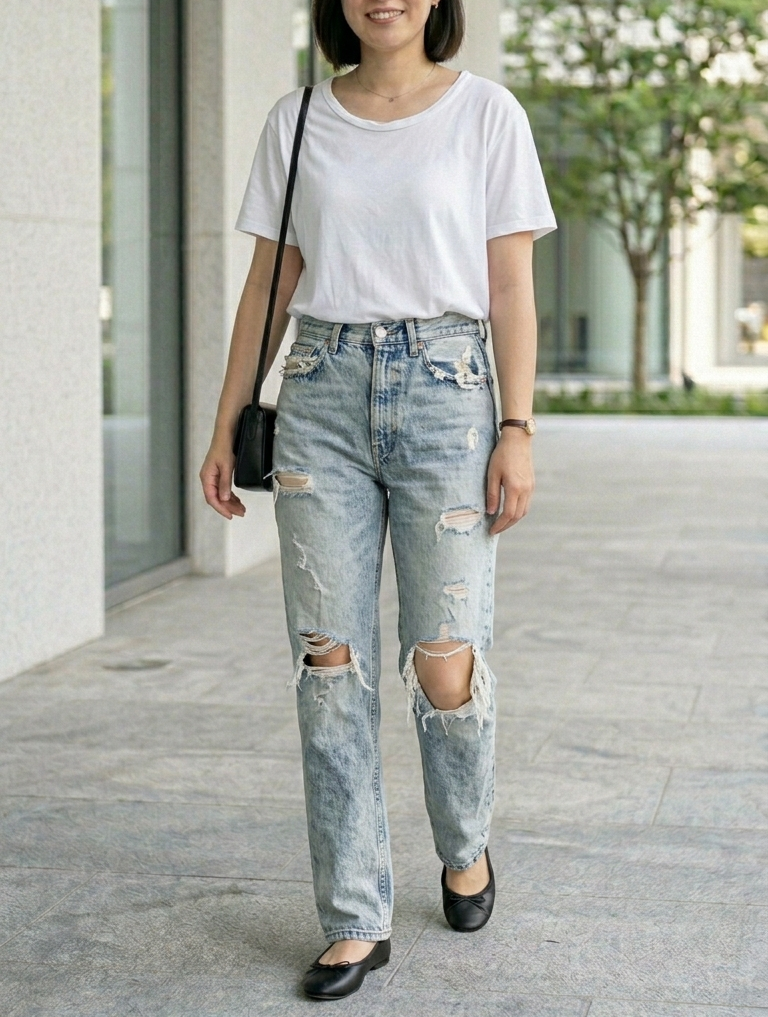
This is an altered version of the Classic white tee and blue jeans we saw above!
We’ve transformed the outfit by giving the jeans big rips and a very faded wash, and making the crisp Classic tee slightly slouchier.
So we suddenly have a very Natural outfit (minus the polished Classic shoes/accessories).
Subtype #2 could be called “Ultra-Casual Natural.” This consists of pieces that have been so elongated or widened, they feel extremely relaxed and carefree:
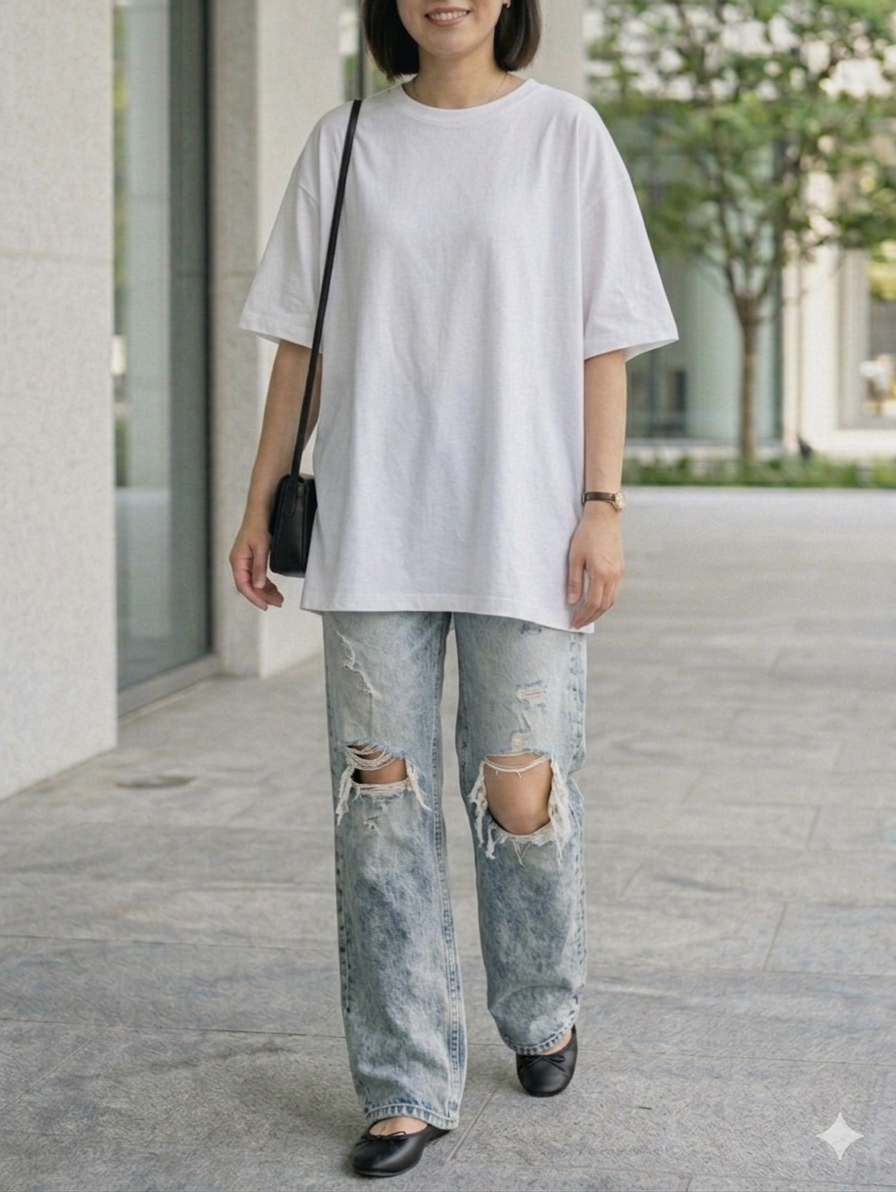
Compared to the previous outfit, this one is even more casual, since the shirt remains unconstructed but now is markedly longer and wider.
Again, these two subtypes are based on our chart:
Casual Natural is the “Blunt and Medium” Natural.
Ultra-casual Natural is the “Blunt and Long” Natural.
Interestingly, Classic and Gamine both have a formal and a casual subtype, because these two essences occupy both the more formal-feeling “Straight” fashion column and the more casual-feeling “Blunt” column.
But Natural only occupies the Blunt column. So both types of Natural fashion feel casual!
Natural Subtypes in Faces
“Casual Natural” faces will tend to have more moderate rather than elongated proportions.
“Ultra-Casual Natural” faces will tend to have marked facial elongation.
While Natural may be stereotypically associated with having elongated features, some Naturals do seem to have moderate proportions.
Especially since many Naturals have strong jaws that can add width to the face, and this tends to make a face look more vertically compact.
Do You Need to Know Your Subtype?
If you’re a Natural, you should feel free to determine your subtype.
I do suspect that for many and perhaps most Naturals, they will be able to look great in both kinds of Natural fashion.
This is because there’s not a huge conceptual difference in vibe between the Natural subtypes! One is simply a more extreme version of the other.
With that said, it’s possible that people with greater facial elongation will find they are most flattered by markedly elongated silhouettes, whereas those with more moderate length in their faces will want to focus on standard-length fashion.
Are there Other Natural Subtypes?
Not that I’m aware of! The two subtypes we’ve discussed already seem capable of accounting for the different kinds of Natural fashion.
Dramatic Essence Subtypes
Subtype #1 is the Elongated Dramatic—think long, sharp, sleek lines:
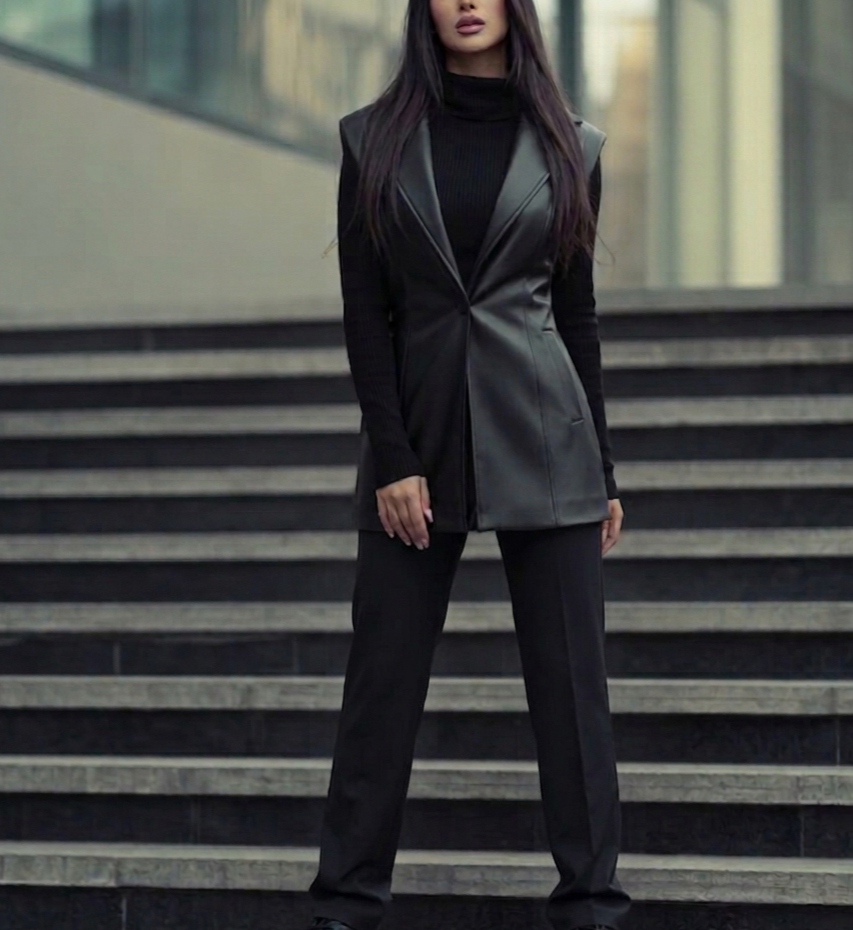
Subtype #2 is the Cropped Dramatic—think very short, sharp, sleek lines (that avoid having Gamine either because they’re extremely minimalist or have edgy detail):
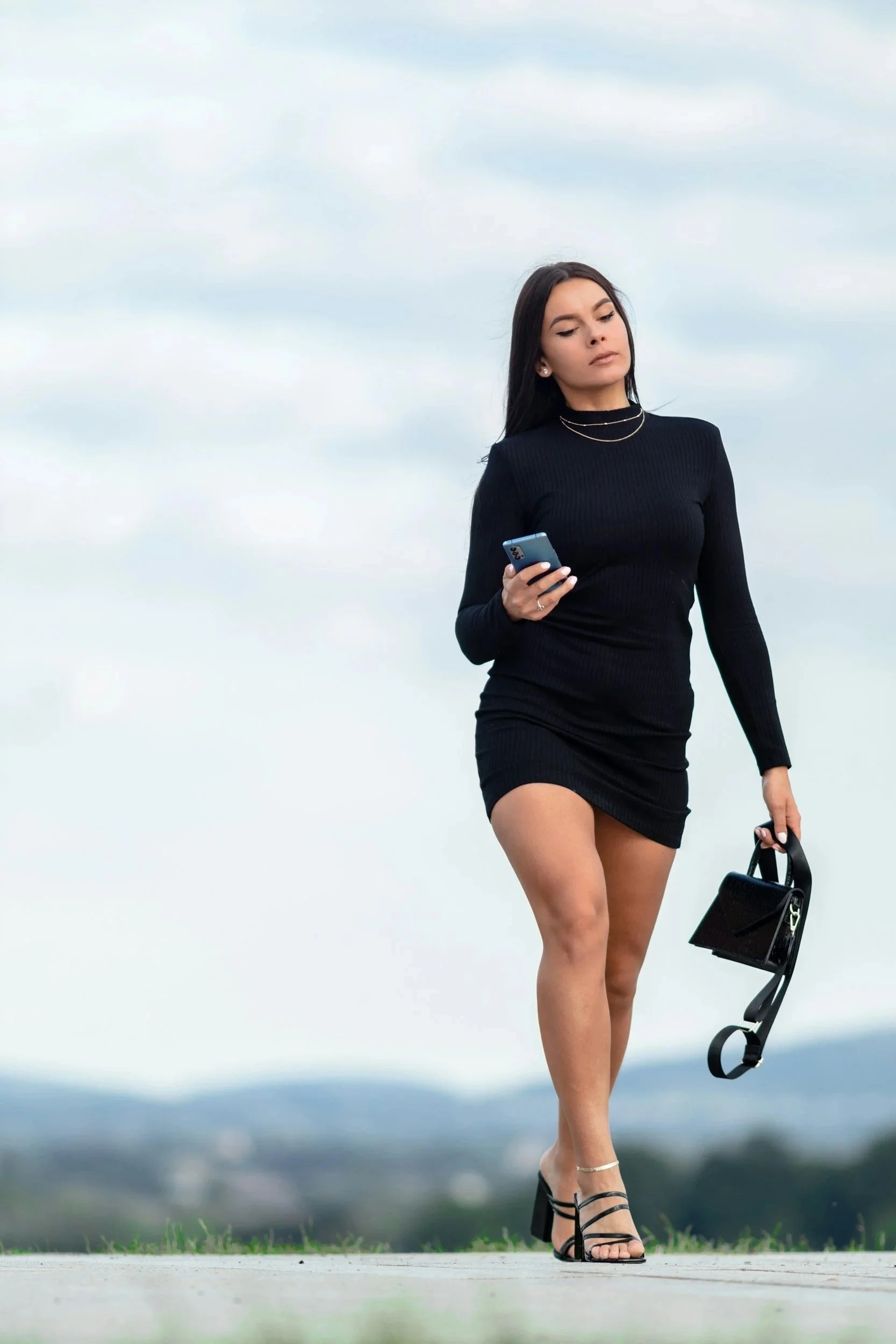
This dress is fully Dramatic because it’s very fitted and very short, with minimal detail. There isn’t the overt playfulness that adds Gamine, or the overt glam detail that adds Romantic. It’s also not moderate enough in length or silhouette to be Classic.
This conceptualization reflects our chart and the reality that edgy-feeling Dramatic fashion can be elongated or cropped.
Dramatic Subtypes in Faces
In faces, we typically think of Dramatic as being characterized by long lines, either that are literally sharp or that are narrow enough to appear striking and intense (even if they’re not literally straight or angular).
And this seems to be the subtype who would wear “Elongated Dramatic” fashion.
Do some Dramatics have short and sharp facial features?
To be honest, I don’t know. I’m unsure if Dramatic facial features can truly be shortened.
It’s certainly possible that they can. But my sense is that short, sharp features are usually Gamine.
But again, there could certainly be exceptions. So, if you’re a person with short, sharp-appearing features that read as striking and Dramatic, then you’ll likely find that Cropped Dramatic fashion is at least a little more flattering on you than Elongated Dramatic fashion.
There’s a couple other instances where you might find that shortened fashion is more flattering on you as a Dramatic:
If you also have a lot of a non-elongated essence, especially Gamine or Ingenue.
To the naked eye, Dramatics often don’t have obviously elongated features. This is perhaps especially true when they have a lot of a shortened essence, like Gamine or Ingenue. So, if this describes you, then you might find that “Cropped Dramatic” fashion works best for your overall blend.
Additionally, Dramatic can manifest in faces not just as vertical elongation but also as horizontal elongation—for example, brows, eyes, and lips can read as elongated if they appear long in horizontal space.
So, this means that you could have Dramatic elongation in your face without having any vertically long features. And in that case, you also might find that you’re flattered by vertically short, Cropped Dramatic fashion.
Do You Need to Know Your Subtype?
It might be helpful to know your subtype as a Dramatic—especially because in a literal sense, the two Dramatic subtypes have a very obvious difference.
However, there’s also a key reason that many Dramatics may not feel the need to consider subtypes:
Dramatic beauty is so striking and powerful, people with a lot of Dramatic tend to “pull off” a wide range of fashion, including both very fitted and wide silhouettes (as long as the fabric is straight and sleek).
So, many Dramatics may find that they can pull off both very long and very short.
Other Subtypes?
What about subtypes for Ingenues, Romantics, and Ethereals?
We’ll cover that next time!